I've been getting a lot of questions about the "cursif" font, which is also called "Cursive School Script". Some people are asking if it's a generic typeface category like cursive or script, while others are looking for a specific named font. This post explains both meanings.
Flowing School Script Style
The cursif style is basically a flowing school handwriting style, not an ornamental calligraphy. It has a very disciplined look, with forms that are somewhat similar to traditional cursive but much more neat and consistent. The lines tend to have a gentle slant, even strokes, recognizable letter shapes, consistent spacing, and built-in ruled lines. I think the most popular example of this style is called "Cursif & Lignes", which you can download from DaFont.
DaFont lists two versions of the font: "Cursif" and "Cursifl". These are separate fonts, but they're related. Both are by Christophe Beaumale, and DaFont shows a 218-glyph view for each TrueType file (with partial accents), though another font mirror lists different technical counts. If you want to use these in your own designs, you should check out their license before relying on them. The ruled-lines Cursifl.ttf version, also listed as Cursif & Lignes, is intended for handwriting worksheets, practice cards, posters, classroom labels, and other learning materials.
License and Commercial Use
There's some conflicting info here. DaFont says “100% Free”, but also says that it’s “mirror commercial-use claims” — i.e., it doesn’t say whether the font is free for commercial use or not. There’s a Creative Commons BY 4.0 attribution statement, so the package’s Polices.doc and Polices.txt files are worth checking if you need certainty. And there’s a contact email listed, so you could ask the author directly. But as far as I can tell, the best thing to do is keep the “100% Free” label and the commercial-use listings in mind, but still verify permission before using it in client work, a product, or anything else commercial.
If you just want a flowing script for design purposes rather than the specific named font, there are several other good original alternatives: Script Signpainter Swash, Script Signature Thin, Script Monoline Loop, Script Copperplate Loop, and Script Brush Signature.
These fonts all have around 95 glyphs each, and they’re great for invitations, signatures, and branding. They’re also easy to copy and paste into word processors, though they don’t support connected script like cursif does.
Unicode Generators and Connected Fonts
You can also make your own cursif-style script by copying the flowy styling of a cursive Unicode text generator, or by installing a connected-script font. Copyable cursive Unicode styling uses a different approach than an installed connected-script font. The generator swaps each normal letter for a separate Unicode script character, so it pastes as plain text but can show fallback boxes and keeps device-controlled spacing. An installed script font is an actual font file, so the app renders its glyphs and can join the letters as a true connected script.
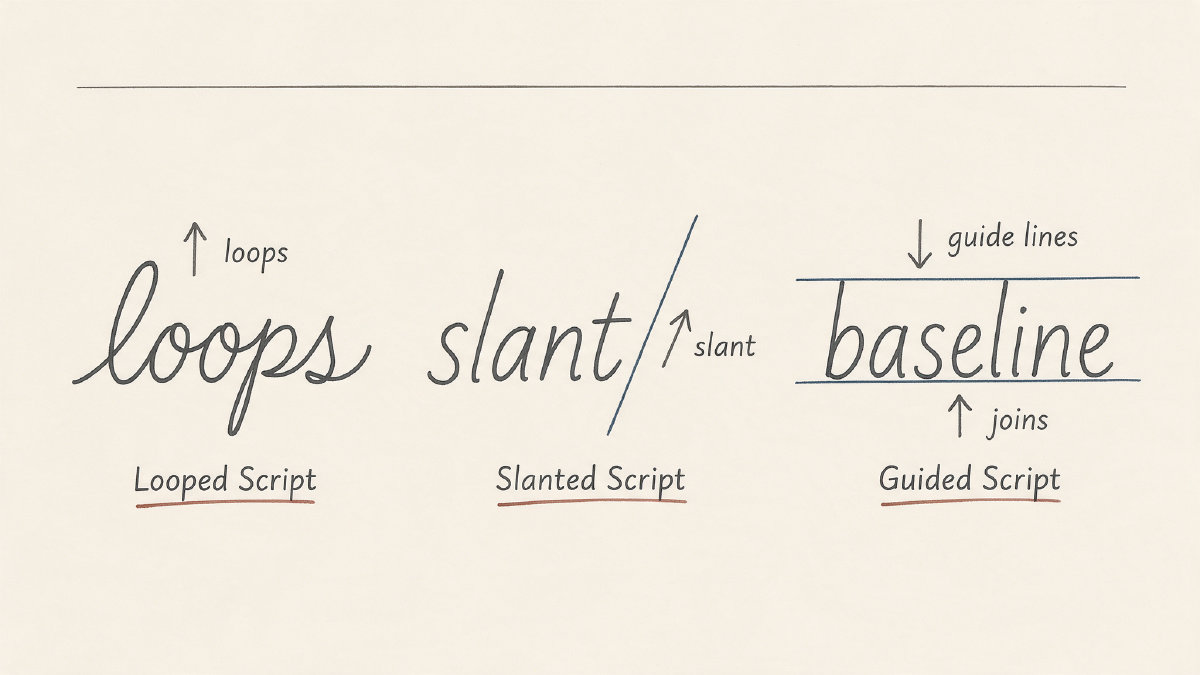
This is why you need to test any script font you want to use in your own project. You can’t just take a font at face value; you have to try it out with custom text and see what traits affect readability. For example, you might find that you prefer a certain amount of connectedness, or a certain slant, or certain loops. I recommend testing the font against words that you’ve written yourself, rather than standard test sentences. Then you can compare them side-by-side to see what looks best. You can also evaluate the font using local font files, or library fonts, depending on your workflow.
Four Cursif Font Options
In short, if you want to use a cursif-style font, you have four options:
Use cursif as a style description. If you’re trying to describe the overall look of a particular font family, you can refer to it as a “cursif” or “cursive school script” style.
Verify the named font’s permission. If you want to use the specific named font, you’ll need to verify its license. As I mentioned above, DaFont isn’t entirely clear on whether the font is free for commercial use, so you should double-check before proceeding.
Choose an original alternative. If you just want a flowing script for design purposes, there are several good original alternatives.
Commission a custom connected script. If you really love the cursif style, you can commission a custom connected script based on your own writing or concept. FontGenerator can build an installable font from a description, reference image, or handwriting sample, with TTF, OTF, WOFF, and WOFF2 downloads.