The name “Theban” can be confusing. In this article, we’ll explore what the term means, how it has been used historically, and how to evaluate fonts that are purportedly using its alphabet.
The meaning of the word
The name Theban has no native grammar or spoken component — just as the Latin-script substitution cipher doesn’t. The geographical meaning refers to Thebes in Greece or Thebes in Egypt, or people/objects from either city.
The Theban alphabet is a form of substitution of an existing writing system (Latin) in favor of an alternative set of letters. It isn’t a language with its own speech or grammar.
The Theban alphabet is also known as the witches’ alphabet or the Runes of Honorius, although it is dissimilar to the Germanic runic alphabet.
In general, then, the Theban alphabet refers to the consistent use of a chosen, named alphabet chart (a particular set of letters). The distinction between common letter substitutions and alternative W conventions is important. As an example, consider:
J → I
U → V
Trithemius: separate W after Z
W: recent Latin-alphabet addition without a standard position
Later translators and copyists, including Francis Barrett: W sign misinterpreted as ampersand or end-of-sentence mark
Some later-chart users: W → VV
Julia → IVLIA
Willow → WILLOW with separate W
VVILLOVV with W → VV
Aids to substitution into Latin script
As the text notes, none of the above are rendered Theban text, nor is there any verification that the font’s keystrokes were indeed mapped onto the intended text.
Why different letter shapes?
Different letter shapes
Historically, charts have had their own traditions, explaining why different letter shapes can be legitimate. The stated chart serves as the basis upon which to judge the legitimacy of each font’s forms.
The difference between unicameral (a single case) and multiletterforms, or variations in the shape of the characters themselves, depends on the source. A comparison of several versions shows that the character shapes have changed over time. This isn’t uncommon; you can find similar differences within a given publication or even within a given page of a publication.
For our purposes, let’s assume that the chart the font is based upon is correct and that any deviation from it is either incorrect or simply stylistic. Some fonts include both capital and lowercase versions, while others may use a hybrid approach, or even a combination.
How to check a font?
How to check a Theban font
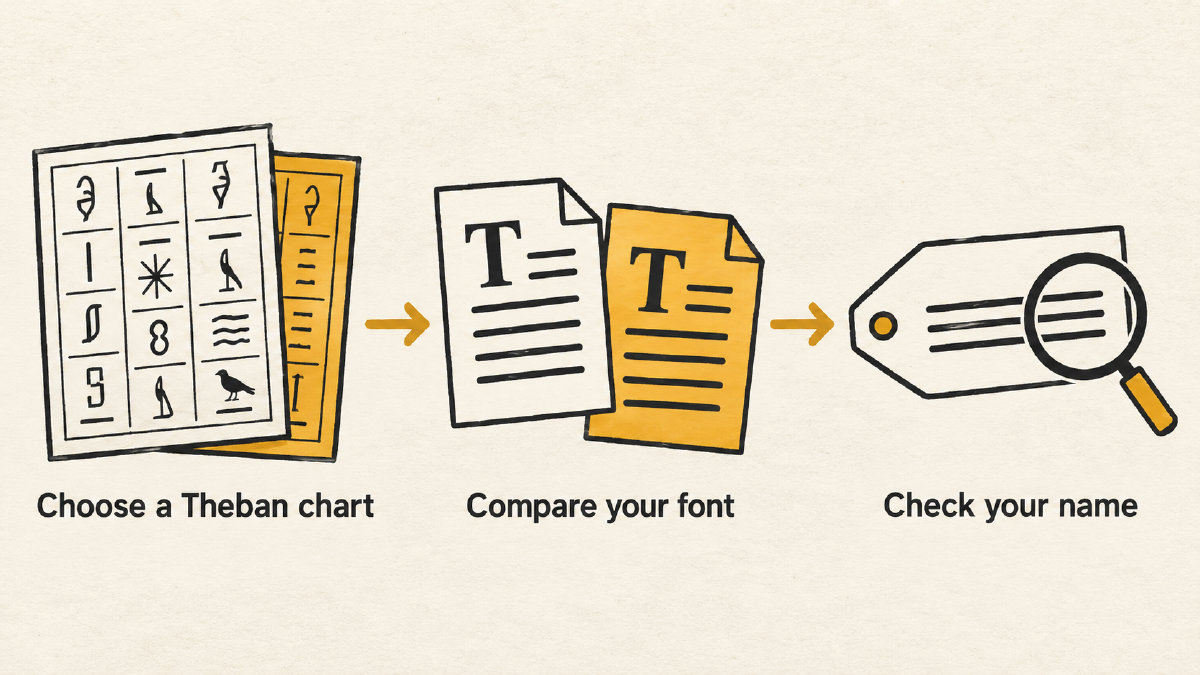
Let’s suppose that the following method would help readers identify whether a font uses the Theban alphabet. You can use FontGenerator’s Font Tester in your browser for these checks. If it does, they should follow the same steps when evaluating other fonts:
Using the documented tester controls, compare both Latin cases with the chosen chart. Inspect ambiguous mappings separately. Then check the intended name, interpreting each preview as evidence about that particular file.
However, the documentation says that the workflow involved the user entering custom text, adding local font files, and doing a side-by-side comparison of those fonts against fonts in the library. In this instance, we’ll be checking the A–Z, a–z, I/J, U/V, W/VV options, along with the chosen chart’s single-case forms.
In this case, the intended name under the selected substitution convention appears to be “theban”, as specified by the file itself. We will observe the mapping for this specific file only, however, noting any differences we see between the intended substitution and the actual font. No identical Latin-keyboard mapping is found across all the fonts.
We propose the following method to evaluate the font: compare A–Z and a–z with the chosen chart, check I/J, U/V and W/VV separately, then try the intended name in your own file.
Separating the coverage of a font’s repertoire from permission
If you want to extend hobby lettering into other uses, you need to inspect your own file, as well as the accompanying license, before doing so. Some fonts add punctuation, numbers and other symbols to their repertoire; other fonts don’t. Therefore, the repertoire of the font cannot be considered universal. Similarly, 1001 Fonts offers the Theban Alphabet by glenn for download; it’s free for personal use, but not for commercial use.
A custom Read Me.txt inside theban-alphabet.zip tells you what the font covers, as well as the license. You won’t get that information from another font.